

Replay of class # 4: Embody Sustainability
-
This is Julia Fehrenbacher’s poem from Poetry of Presence II
It could bea smile or a poem. Or new day light
that finds you through an open
window. Or, perhaps, remembering
that tomorrow was never promised.
It could be the scent
of baking bread, the first chill
of autumn that has you reaching
for your favorite wool sweater. Or maybe
it’s the noticing of how easily
red maple becomes and lets go.
It could be taking today off
to be still, to un-know,
to notice. To practice loosening
your troubled grip
because grace can never
be gripped or grabbed.
It could be choosing
softness in a world grown hard
because you’re tired of hurting
and being hurt and mercy
is the best kind of medicine.
It could be an invitation to gather
around the listening table
where every color is beautiful, where
there is no blame,
no shame, no them– no other.
It could be any of these things
or no thing at all, that remind
you that really, only a few
things matter
Food. Trees. Words. Love. Mostly love.
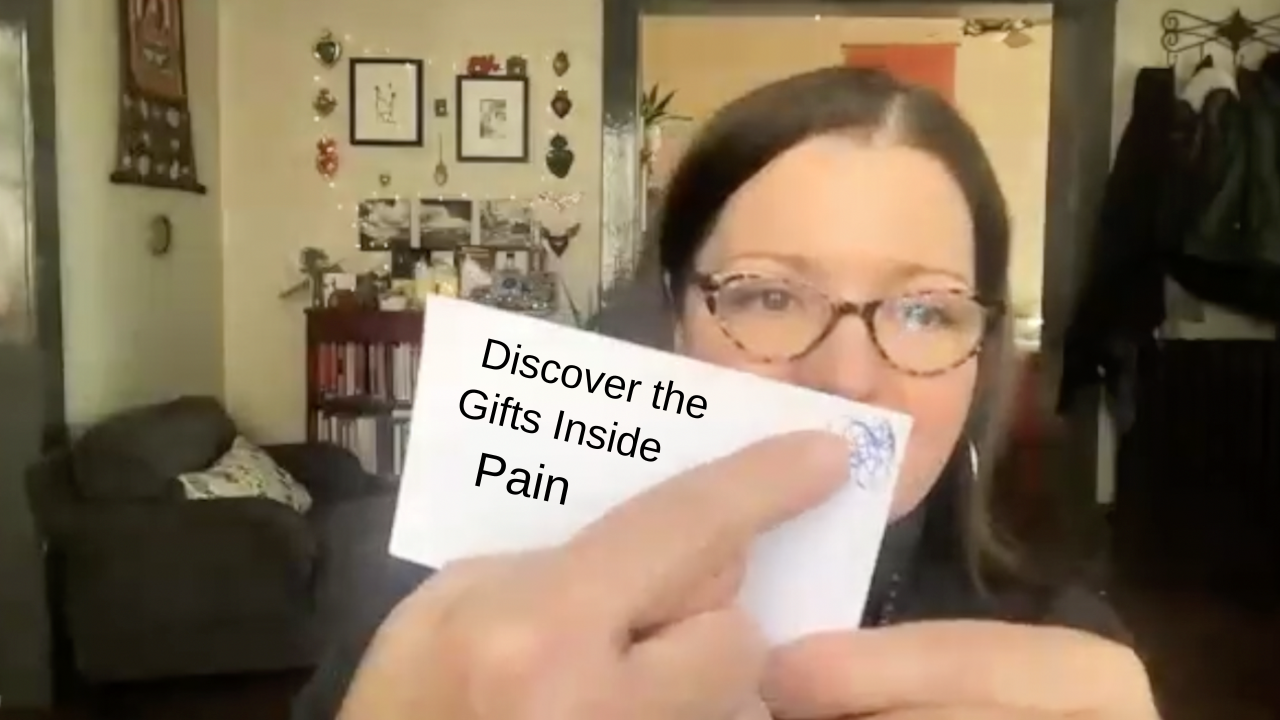
Replay of class #3 - Discover the Gifts Inside Pain:
-
(posted online as "written by a Chinese doctor") and also here
I am the pain in your head, the knot in your stomach, the unspoken grief in your smile.
I am your high blood sugar, your elevated blood pressure, your fear of challenge, your lack of trust.
I am your hot flashes, your cold hands and feet, your agitation and your fatigue.
I am your shortness of breath, your fragile low back, the cramp in your neck, the despair in your sigh.
I am the pressure on your heart, the pain down your arm, your bloated abdomen, your constant hunger.
I am where you hurt, the fear that persists, your sadness of dreams unfulfilled.
I am your symptoms, the causes of your concern, the signs of imbalance, your condition of dis-ease.
You tend to disown me, suppress me, ignore me, inflate me, coddle me, condemn me.
I am not coming forth for myself as I am not separate from all that is you.
I come to garner your attention, to enjoin your embrace so I can reveal my secrets.
I have only your best interests at heart as I seek health and wholeness by simply announcing myself.
You usually want me to go away immediately, to disappear, to slink back into obscurity.
You mostly are irritated or frightened and many times shocked by my arrival.
From this stance you medicate in order to eradicate me.
Ignoring me, not exploring me, is your preferred response.
More times than not I am only the most recent notes of a long symphony, the most evident branches of roots that have been challenged for seasons.
So I implore you, I am a messenger with good news, as disturbing as I can be at times.
I am wanting to guide you back to those tender places in yourself, the place where you can hold yourself with compassion and honesty.
If you look beyond my appearance you may find that I am a voice from your soul.
Calling to you from places deep within that seek your conscious alignment.
I may ask you to alter your diet, get more sleep, exercise regularly, breathe more consciously.
I might encourage you to see a vaster reality and worry less about the day to day fluctuations of life.
I may ask you to explore the bonds and the wounds of your relationships.
I may remind you to be more generous and expansive or to attend to protecting your heart from insult.
I might have you laugh more, spend more time in nature, eat when you are hungry and less when pained or bored, spend time every day, if only for a few minutes, being still.
Wherever I lead you, my hope is that you will realize that success will not be measured by my eradication, but by the shift in the internal landscape from which I emerge.
I am your friend, not your enemy. I have no desire to bring pain and suffering into your life.
I am simply tugging at your sleeve, too long immune to gentle nudges.
I desire for you to allow me to speak to you in a way that enlivens your higher instincts for self-care.
My charge is to energize you to listen to me with the sensitive ear and heart of a mother attending to her precious baby.
You are a being so vast, so complex, with amazing capacities for self-regulation and healing.
Let me be one of the harbingers that lead you to the mysterious core of your being where insight and wisdom are naturally available when called upon with a sincere heart.
-
Mythologist Michael Meade said:
"You think you need more time. You actually need more experiences of the timeless."
-
“The most important movement in the whole Feldenkrais repertoire is the movement of your attention."
Replay of Class #2 - Befriend Yourself:
Some helpful words from Erin about this class + some beautiful quotes and poems she read
-
"Go slowly enough that your imagination can catch up with what your lack of imagination is doing."
-
When asked how he became so kind, Stephen Levine answered, "By noticing how unkind I was." (From To Love & Be Loved: The Difficult Yoga of Relationship audio program from Sounds True.)
I shared, inspired by Thich Nhat Hanh, "Darling, I care about your suffering."
-
And finally, from the little book called Open & Innocent: The Gentle, Passionate Art of Not Knowing by Zen teacher Scott Morrison, one of my favorite teachings. In fact, he calls this "The Whole Teaching."
"The path of awakening and liberation requires that we ask ourselves just this one fundamental question:Do I wish to live this moment with as much attention, care, and affection as possible, or am I going to do something else?
There’s no point in judging the “something else” as either good or bad; it’s just that it’s important to know who’s making the decisions."

Replay of Class #1 - Age Gracefully:
Some helpful words from Erin about this class + some beautiful quotes and poems she read
-
The main thing you will need for this lesson is curiosity.
You will also need a a space to lie on the floor (ideally with enough space around you to move around a bit. You can also use a bed if you can’t lye on the floor.
And wear comfortable clothing (no tight jeans :)
-
If parts of this lesson are beyond what is possible or pleasurable for you at this time, please don’t push yourself.
You might choose to simply do the first part lying on the ground, rolling your head, then rolling yourself from side to side.
You might then add the piece that includes lying on your side, letting the leg movement roll your torso - if that feels good.
There is SO much to learn and refine in EACH of these movements.
Maybe someday it will feel good to weave them with the movement of swooping up to sitting - and maybe not. Truly it doesn't matter. It took me a long time to wrap my mind around this. The movement is only the vehicle for a particular kind of learning - the form is not as important as the inner intimacy and refinement you're engaged in.
As I mention in the lesson, I invite you to let your ambition be about growing awareness and growing a sense of pleasure and ease in your movement - *not* being ambitious to do anything that takes you out of the range of sustainable, pleasurable movement.
-
We include here the video of Tiffany doing the movement lesson.
Please know that what she is doing is not “the right way” to do the lesson.
As Feldenkrais said, ‘Why would you want to get to right? You can’t improve on “right.”
We aim to grow a quality of curiosity that allows us to continually improve according to how it feels from the inside.
What Tiffany is showing is what felt pleasurable to her on this particular day.
Your range, your speed, your style and quality may be different and that is most welcome.
Some of you may find it helpful to have a visual reference if my verbal cues aren't making the movement invitation clear. We hope this helps!
The overarching theme in this lesson is articulated in this quote from Ruthy Alon:
“With the passing of each day and each year, you are able to perform every act in an increasingly better way – more efficiently, more wisely, more precisely and economically – provided that you have not relinquished your determination to seek these qualities.”
-
“The more your brain increases your body’s intelligence, the closer you come to a level of functioning which goes beyond the minimum need for existence. You begin to break through to what appeals to you. At this level of competence you begin to grasp where an adult human brain can reach, had it not been hindered in the early stages of development.”
“Improvement of specific movements in the process of learning becomes merely a bonus, the real gain being that your life takes on a new, positive direction. This means that with the passing of each day and each year you are able to perform every act in an increasingly better way – more efficiently, more wisely, more precisely and economically – provided that you have not relinquished your determination to seek these qualities.”
from page 41 in the chapter called Biological Optimism
-
This is part 7 of Mary Oliver's poem called To Begin with the Sweet Grass, from her book Evidence.
What I loved in the beginning, I think, was mostly myself.
Never mind that I had to, since somebody had to.
That was many years ago.
Since then I have gone out from my confinements, though with difficultyI mean the ones that are thought to rule my heart.
I cast them out, I put them on the mush pile.
They will be nourishment somehow
(everything is nourishment somehow or another).And I have become the child of the clouds, and of hope.
I have become the friend of the enemy, whoever that is.
I have become older and, cherishing what I have learned,
I have become younger.And what do I risk to tell you this, which is all I know?
Love yourself. Then forget it. Then, love the world.

In 2018, Erin Geesaman Rabke wrote a widely read and translated article, Why Do Feldenkrais? exploring many fresh ideas about why the Feldenkrais Method® is important personally and even culturally.
Explore these 20 potent themes in a series of enlivening 30 minute Feldenkrais lessons.
1. Age Gracefully
2. Befriend Yourself
3. Discover the Gifts Inside Pain
4. Embody Sustainability
5. Cultivate Less Effort & More Pleasure
6. Decolonize Your Bodymind
7. Feel More
8. Update Your Habits
9. Learn to Slow Down
10. Become Authentically Intelligent
11. Improve Your Brain's Map of Your Body
12. Grow Your Attentional Flexibility
13. Be Mindful and Spontaneous
14. Become Yourself
15. Do What You Want
16. Learn to Trust Something Other than Your Thinking Mind
17. Practice Systems Thinking
18. End the Culture of Domination
19. Embody Ancestral Healing
20. Nurture Reverent Curiosity

Who this is for:
For people new to Feldenkrais who want an experiential understanding of the potential breadth and depth of this approach.
For experienced students of Feldenkrais, including professional Feldenkrais teachers, who are curious about fresh ways to understand the profound impacts of this method.
For anyone who is curious about embodied learning, mindfulness, sustainability, movement, and liberation.
We are practicing to bring something radical to our lives and to the world.
Embodied presence. Less aggression. More compassion. Less domination. More listening. Greater presence.
In the Why Feldenkrais series, we’re not aiming to tune out the wider world but resourcing ourselves to meet it in sustainable, creative, and life-giving ways.
As we reduce unnecessary and often unconscious aggression in our own movement and postural habits, we’re reducing the amount of aggression in the world.
As we embody more lovingkindness in both how we move and how we pay attention, we’re creating a more warm-hearted, accepting presence in the world - both inner and outer.